Reports

See why competitors are winning customers and what to change next

Pick Lite for a quick paid diagnosis, Pro for the main working report, or Deep when you need hidden-funnel evidence before making bigger changes.

Lite A fast read on the competitor pressure. Pro The default benchmark and action document. Deep Pro plus deeper capture when the real move is hidden.

Pro is the default when the leak is already costing money. Use the free check only if you still need a lighter proof step before buying.

This page leans on proof you can inspect yourself: actual output examples, source-linked evidence, and delivery standards instead of anonymous quotes or a decorative logo wall.

Reports pricing

Choose the paid report depth that fits the decision in front of you

Lite is the smallest paid step, Pro is the main report for most buyers, and Deep adds hidden-funnel evidence when public pages are not enough.

1 competitor | paid proof step

Lite

$149 ~48 hours

Best when you want a small paid proof step before deciding whether the full Pro benchmark is worth it.

  • Executive summary with a single-competitor scorecard
  • Top conversion, offer, and trust gaps from visible evidence
  • Immediate next-step recommendation for what to change first
  • Small paid proof step before the fuller Pro benchmark
Buy Lite

Pro plus hidden-funnel evidence

Deep

$428 48-72 hours

Best when public pages are not enough and deeper funnel evidence could change the recommendation.

  • Everything in Pro
  • Selective signup, quiz, cart, or welcome-flow capture when the real offer appears after the first click
  • Hidden-funnel evidence from what competitors reveal beyond the public page
  • Sharper CTA, offer, and follow-up diagnosis when the homepage does not tell the whole story
Buy Deep

Optional proof step

Free Competitor Check

Free scan

Use the free competitor check when you still want proof before buying. The paid report is the main path once the leak is expensive enough to act on.

Rules-first preview with one clear signal and a clean next step if you want to go deeper.

  • Rules-first competitor pressure read
  • One visible offer, proof, pricing, or CTA leak
  • Clear next step if deeper paid coverage makes sense

Fit

Use the report when a one-time decision needs a sharper answer

This lane is for teams deciding what to change next. It is not the recurring retainer, and it is not a generic audit that leaves the team assembling the answer alone.

Who it's for

Founders, marketers, and operators making a specific decision

Use Lite or Pro when you need a clean competitor read before changing the offer, pricing, page, funnel, or acquisition angle.

What it's for

Reduce guesswork before the team changes something important

The report is built to help you decide what to change next, not bury the answer in a huge deck.

What you receive

Screenshots, competitor notes, and a short action list

Every report ends with next moves founders, paid, CRO, or product teams can use right away. Deep adds hidden-funnel proof when needed.

What it is not

Not a recurring retainer and not vague consulting

Reports are the one-time product. Monitoring stays separate, Revenue Leak Validation follows only when client data is needed, and Custom Systems comes in when the workflow itself needs to be built.

See the output early

View the kind of signal and action packaging you are buying

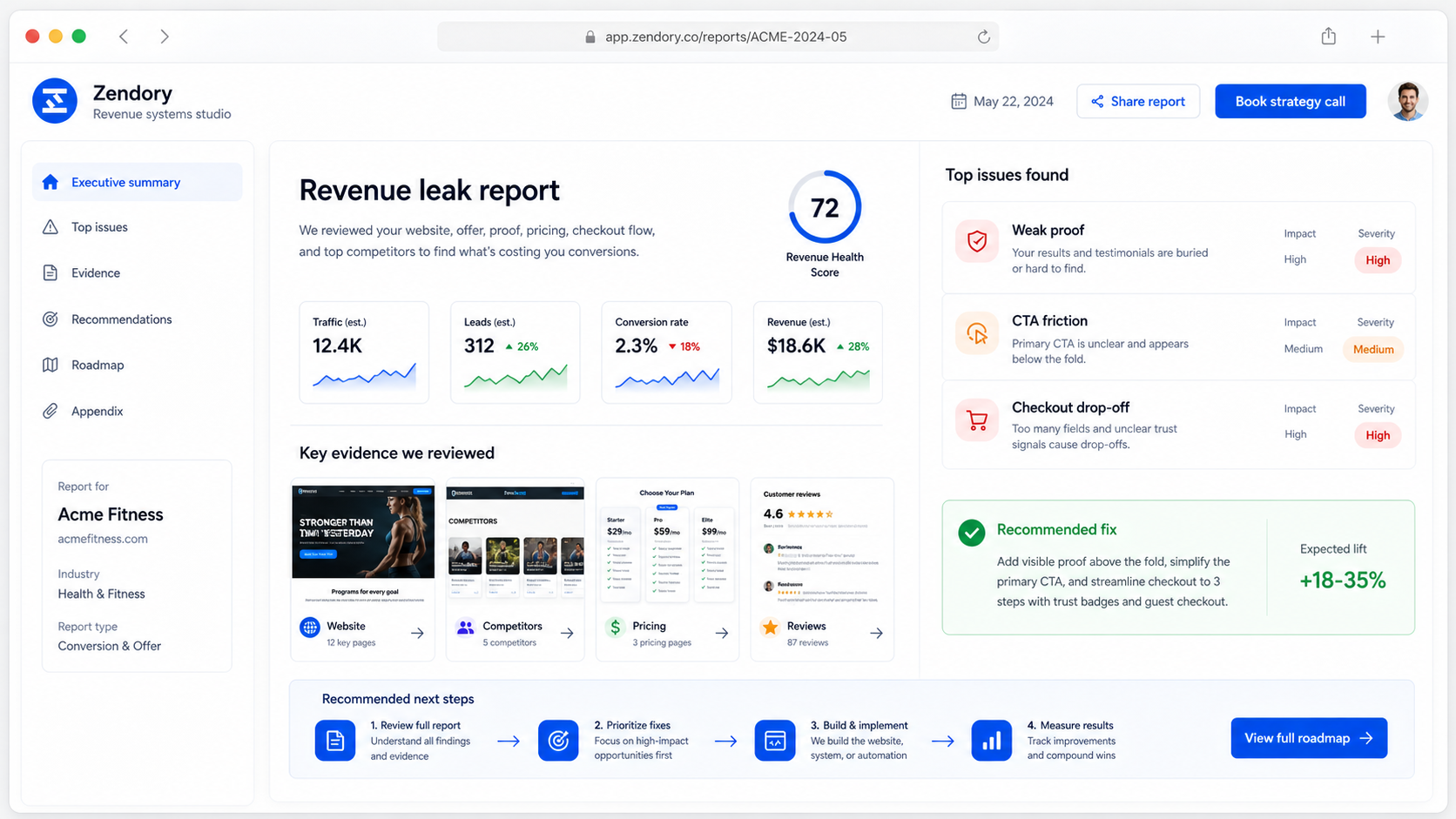
Use the sample to see how Zendory turns competitor evidence into concrete next steps for the team.

What happens after purchase

You send the brand, target category, and primary goal. Zendory confirms whether Lite is enough, Pro is the better default, or Deep is justified by hidden funnel steps.

What you receive

A readable teardown with benchmark notes, scorecards, screenshots, and clearer priorities for what the team should change next.

How the buying path stays cleaner

Lite is the proof step, Pro is the money plan, and Deep only comes in when the extra evidence materially changes the recommendation.

Detailed sample

A sample of the kind of signal that turns into better conversion decisions

Visible bundle math, shipping reassurance, and review density are easier to trust on competitor pages, so traffic arrives warm and still leaks before the first CTA click.

  • Move the hero from generic brand language into one concrete bundle promise with the savings math visible.
  • Pull review volume, delivery promise, and returns reassurance into the first viewport instead of leaving them lower on the page.
  • Simplify the primary CTA path so paid traffic sees one collection entry and one subscribe-and-save path, not three competing actions.

Sample report snapshot

72-hour competitor improvement teardown One executive summary plus role-specific action blocks and an evidence appendix.

Top pressure

Sparkwear is losing high-intent clicks to clearer bundle framing and stronger proof above the fold. Offer clarity

Ship this week

Move the hero from generic brand language into one concrete bundle promise with the savings math visible. Pull review volume, delivery promise, and returns reassurance into the first viewport instead of leaving them lower on the page.

First owner

Founder view Treat the first conversion leak as offer packaging, not as a traffic-volume problem.

Sections included

Suggested depth

Pro Use the full teardown when the team needs the clearest action document.

Why this over DIY

The report is meant to replace scattered guesswork with one usable decision package

Most alternatives produce fragments. The point of the paid report is to package the market pressure, evidence, and next actions into one thing the team can circulate and act on.

What you might do instead
What usually happens
Why buyers choose the report
Do it manually

You end up with screenshots, tabs, and scattered notes that someone still has to translate into a decision.

The report packages the benchmark, evidence, and next moves into one readable document the team can circulate.

Ask AI for a teardown

You get ideas quickly, but the evidence, ranking, and action packaging still need to be checked and stitched together.

Zendory keeps the answer tied to visible competitor proof and ranks what matters first instead of stopping at commentary.

Buy a generic audit

The output usually covers fragments of CRO, SEO, or messaging without showing who in the market is actually creating the pressure.

The report stays centered on competitor pressure, why it matters now, and what to change before you spend time implementing.

Move fast without structure

The team makes changes quickly, but they are often based on instinct rather than a shared market read.

Lite, Pro, and Deep give you a cleaner paid path from quick diagnosis to full teardown without vague consulting in the middle.

Plan chart

What each report tier actually includes

Use Lite for the smaller paid entry, Pro for the fuller working document, and Deep when you need the Pro package plus hidden-funnel capture.

Plan chart

What each report tier actually includes

The third tier is the full Deep package, so it includes the Pro deliverables plus the extra evidence layer.

Feature LiteProDeep
Executive summary
Competitor scorecard
Top conversion and offer gaps
Next-step recommendation
Priority matrix
Role-specific actions
Strategy pack
Signup or quiz checks
Cart or checkout evidence
Welcome-flow or hidden-funnel capture

What arrives

The deliverable should still feel concrete after the tier choice is clear

Once the buyer understands the ladder, show the named files and action packaging that make the report usable by the team right away.

Executive summary

A readable first section that explains where the market is stronger, where your angle is exposed, and which gaps matter first.

Scorecards and execution blocks

Founder, paid, landing-page, and outbound handoffs so the report can move into execution instead of stopping at commentary.

Priority matrix and response plan

Ranked response priorities, sharper benchmark framing, and a clear plan for what to copy, counter, and change next.

Focused briefs

Buy the narrower report when the question is already specific

These offers are for teams that do not need the full report every time. They still run on the same reporting runtime, but the packaging stays tighter around one decision.

Offer Gap Brief

Focused report

Use this when the core question is where competitor offers, bundles, pricing, or proof pressure your current positioning.

  • Executive summary
  • Scorecards
  • Priority matrix

Creative Response Brief

Focused report

Use this when you know the market move and want paid, landing-page, and outbound counter-moves packaged tightly.

  • Response plan
  • Scorecards
  • Execution checklist

Category Snapshot

Focused report

Use this when you want a narrower category read before commissioning the full teardown.

  • Executive summary
  • Scorecards
  • Category pattern map

Premium upsell

Revenue Leak Validation

Use this after Pro or an equivalent public-evidence teardown when you need to confirm which leak is actually costing money inside your own analytics and commerce data.

  • Built for post-teardown validation, not for first-pass diagnosis
  • Zendory requests analytics, commerce, CRM, or lifecycle exports after the intake is reviewed
  • Final output ranks the validated leak, explains why it is real, and narrows what the team should fix first
  • Best when public evidence narrowed the suspects but first-party data is needed to make the call safely

How it differs from the base report

The base report uses public evidence. Validation uses first-party client data after the likely leak is already visible.

That keeps the first purchase simple, then adds the heavier analytics and commerce intake only when the team needs proof of which leak is real inside the funnel.

Separate upsell

Monitoring is the clean next step after the report

Keep the one-time report clean. If you want recurring visibility afterward, use monitoring as the next purchase instead of bloating the base report packages.

  • Monthly recap on visible offer, pricing, proof, and CTA changes
  • Launch Watch adds priority alerts between recaps when the movement is high-signal
  • Built on top of the report competitor baseline
  • Best for teams that already saw value from the one-time report

Why it is separate

Lite, Pro, and Deep are the first purchase. Monitoring is the retainer after the report proves useful.

That keeps the buyer journey cleaner and makes the upsell more credible. You are not asking someone to buy a recurring service before they have seen the baseline work.

Other products

If the report works, these are the next two lanes

Reports should stay the first purchase. These two only matter after the baseline is useful or when the workflow itself becomes the bottleneck.

Monitoring

Use the recurring layer after the report baseline exists and the job becomes tracking new competitor changes over time.

See Monitoring

Custom Systems

Use the higher-touch lane when the workflow itself needs to be built, automated, or run as an operating system.

See Custom Systems

Detailed sample

What the report actually includes

Sparkwear is losing high-intent clicks to clearer bundle framing and stronger proof above the fold.

Format

72-hour competitor improvement teardownOne executive summary plus role-specific action blocks and an evidence appendix.
  • Move the hero from generic brand language into one concrete bundle promise with the savings math visible.
  • Pull review volume, delivery promise, and returns reassurance into the first viewport instead of leaving them lower on the page.
  • Simplify the primary CTA path so paid traffic sees one collection entry and one subscribe-and-save path, not three competing actions.

Role blocks

Founder viewTreat the first conversion leak as offer packaging, not as a traffic-volume problem.
Paid media viewPaid traffic can keep flowing, but the first tests should now reduce landing-page comparison friction.
Landing page owner viewThe page should do the pricing, proof, and CTA work immediately instead of making the shopper scroll to find reassurance.