
Monitoring
Monitor competitor changes before they cost revenue
Keep your report benchmark current with monthly recaps, priority alerts, and escalation when a competitor changes something big enough to matter.
Start with the report once, then use monitoring to keep that benchmark current without buying another teardown every month.
Pricing
Choose the recurring depth first and use the free preview only if you still need proof
Alert Digest is the clean first retainer. Launch Watch adds earlier escalation. Scale Watch broadens coverage.
Recurring monitoring
Alert Digest
$99 / month
Best first paid monitoring step when the baseline already exists and you want one ranked monthly recap.
- Monthly recap on the report competitor set
- Prioritized changes across offer, pricing, proof, and CTA shifts
- Baseline reuse so the work stays focused on what changed
- monitoring_summary.json style recap with the changes that matter most
Recurring monitoring
Launch Watch
$249 / month
Best when the category moves fast and you want the monthly recap plus early escalation on strategic changes.
- Everything in Alert Digest
- Launch-watch framing for high-priority competitor movement
- Priority alerts between monthly recaps when a move looks important enough to escalate
- Selective deeper checks when the visible change looks meaningful
- Sharper operator-facing packaging for what to respond to now
Recurring monitoring
Scale Watch
$499 / month
Best when the business already depends on recurring competitor visibility and needs broader coverage with faster escalation.
- Everything in Launch Watch
- Broader competitor-set coverage across the same lane
- Faster escalation when a change looks materially higher-stakes
- Expanded operator-ready recap packaging for a larger team
- Best when the watch itself has become part of operating cadence
Optional proof step
Free Competitor Alerts
Use the free alerts preview when you want to see how one visible competitor change gets surfaced before deciding whether the post-report monitoring layer is useful.
Rules-first preview with one clear signal and a clean next step if you want to go deeper.
- Rules-first change preview
- One visible pricing, proof, offer, or CTA shift
- Clear next step if you want recurring post-baseline coverage
If you do not have the baseline yet, start with a report. Monitoring pays for current signal, not repeated discovery work.
Lifecycle
The path from one-time baseline to recurring monitoring should be obvious
This is the sequence: baseline first, recurring recap second, escalation only when the change is bigger than the retainer should carry.
Step 1
Start with the report when the baseline is still unclear
The first purchase should identify who matters, where the visible pressure is coming from, and what good looks like today before a recurring watch layer makes sense.
- Use Reports when the core competitor set is not locked yet
- Get the first benchmark, screenshots, and actions in one pass
- Only add the retainer after the initial read already proved useful
Buy once to set the baseline and the competitor set
Step 2
Use monitoring to keep the baseline current every month
Retention makes sense when the team already knows the market and now wants a cheaper recurring layer that surfaces visible pricing, offer, proof, CTA, and launch changes before they quietly hurt conversion.
- Monthly recap on the same competitor set instead of another full teardown
- Priority-ranked movement across pricing, proof, CTA, and offer shifts
- Launch Watch escalation only when something looks strategic enough to flag early
Retention buys current signal, not repeated discovery work
Step 3
Escalate only when the change deserves a bigger response
Monitoring should stay focused. When the recap surfaces a bigger competitive move, the next step is a focused brief or implementation project, not padding the monthly retainer with a different job.
- Use focused briefs when the alert needs a deeper strategic answer
- Use Custom Systems when the alerting logic needs to become a real implemented system
- Keep the standard monitoring plans tight so the recurring value stays obvious
Escalate when the move is bigger than a recap
What arrives
The recurring output should be visible before someone buys
The buyer should know what shows up each month, how it protects response quality, and how it is different from a full report.
Monthly operator recap
A recurring recap of the visible edits that matter most across the same competitor set, packaged so the team can scan it fast.
Priority ranking and escalation logic
Changes are packaged in order of importance so the team knows what to react to first, with launch-watch escalation reserved for higher-stakes movement.
Launch Watch + selective deeper checks
A higher-touch watch layer for strategic movement, with selective deeper checks and priority alerts between recaps when the change deserves faster attention.
Escalate when needed
Monitoring catches the change. Focused briefs package the response.
If the recap surfaces a bigger move than a monthly note should carry, the clean next buy is a focused report instead of forcing the retainer to do a different job.
Offer Gap Brief
When a monitored pricing, bundle, or positioning move looks structural, escalate into a focused brief that explains where the pressure is coming from.
Creative Response Brief
When the alert tells you something changed and the team needs the counter-moves packaged for paid, landing-page, or outbound execution, use the creative response brief.
What it tracks
The visible changes that matter most
Monitoring stays useful because it focuses on practical signals your team can actually respond to, then packages them as monthly recap or launch-watch context instead of raw noise.
Offer and pricing shifts
Track when competitors change visible pricing, guarantees, bundles, or offer framing after your initial report.
CTA and funnel changes
Watch for meaningful CTA, funnel-entry, and conversion-framing changes across the same competitor set without paying for another first-pass teardown.
Proof, launch, and trust changes
Notice when competitors add reviews, claims, badges, launch-style updates, proof blocks, or stronger social evidence.
Recurring operator summaries
Get concise prioritized alerts and recaps your team can use instead of repurchasing a full report every time you want a market pulse.
Cadence view
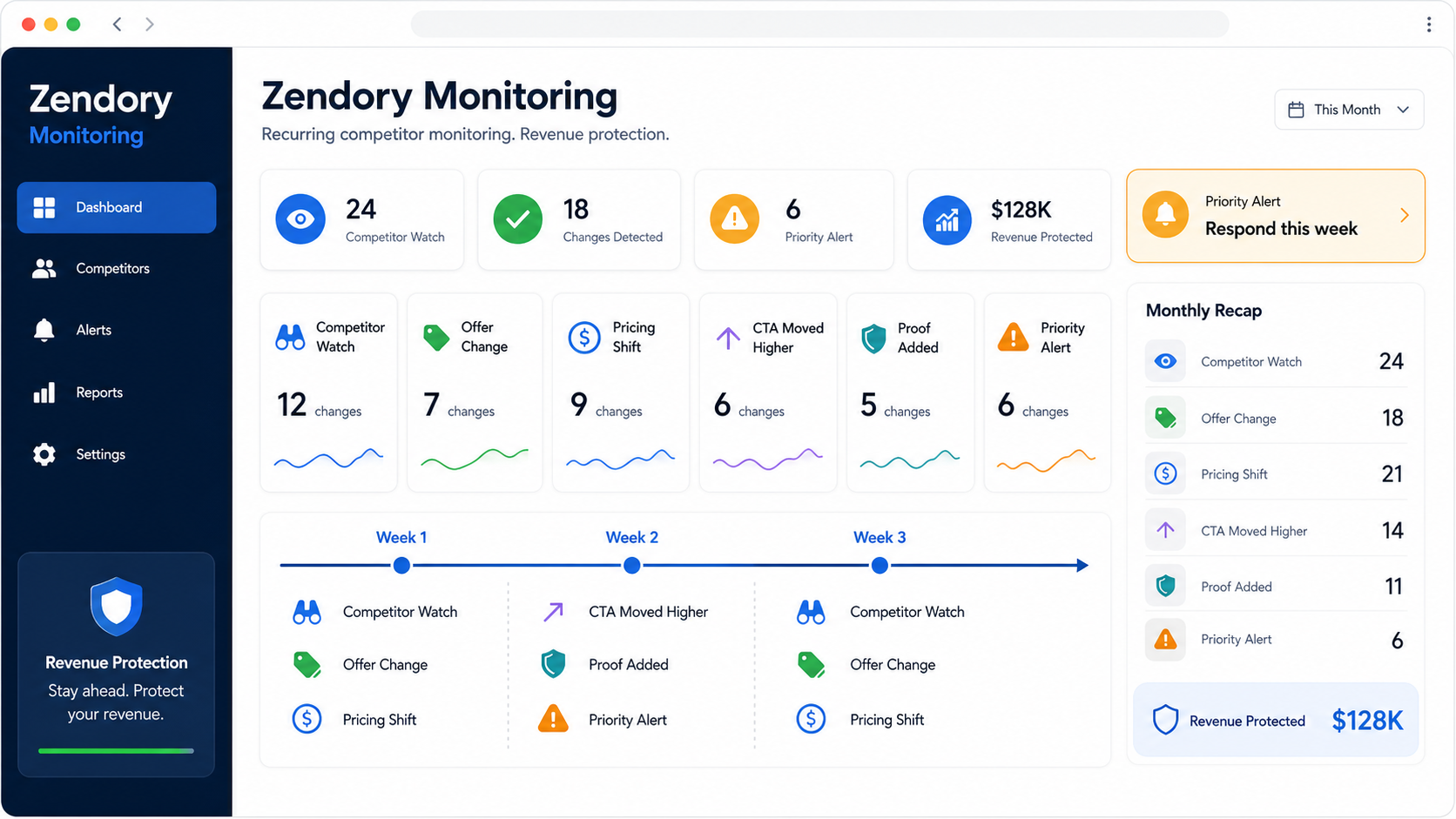
How the monthly recap and launch-watch escalation show up over time
Instead of another full report every time, you get a lighter recurring layer built on the same competitor set, with higher-priority movement surfaced between recaps only when it is worth escalating.
Week 1
01Bundle changed
A core competitor moved from a single-offer page to a bundle-led message with stronger guarantee framing.
Week 2
02CTA moved higher
Another competitor shortened the page and pushed the first CTA block much earlier in the layout.
Week 3
03Proof block expanded
A new review strip and metric row were added above the fold, changing how trust lands on first visit.
Plan chart
Choose the monitoring plan by escalation depth, not by guesswork
Alert Digest is the clean first retainer. Launch Watch adds early escalation. Scale Watch broadens coverage for teams already relying on the watch layer.
Plan chart
What each monitoring plan actually includes
Start with Alert Digest if you want the recurring recap. Move up only when the category moves fast enough to justify earlier alerts or broader coverage.
| Feature | Alert Digest | Launch Watch | Scale Watch |
|---|---|---|---|
| Monthly recap | |||
| Priority-ranked changes | |||
| Competitor set reuse | |||
| Between-recap alerts | |||
| Launch escalation | |||
| Selective deeper checks | |||
| Broader competitor coverage | |||
| Higher-touch operator packaging |
Optional proof
Use the free alerts preview only if the team still wants proof first
The free alerts preview stays useful for buyers who are curious about monitoring but not ready to start the monthly plan yet. It is an optional proof path, not the main route.
- Website-first setup
- Optional email follow-up
- Clear path into Alert Digest or Launch Watch once the signal is useful
Lower-friction entry:
Website first Email required Preview link delivered
Article cluster
Read the monitoring and operator-workflow articles first
This content cluster is for buyers who already have the baseline and now need ongoing change detection.
A Competitor Monitoring Playbook for Fast-Moving Markets
How to build recurring competitor monitoring that catches pricing, proof, CTA, and launch changes before they cost pipeline or conversion rate.
Why Ecommerce Teams Burn Out on Competitor Research Even When They’re Good at Growth
Most burnout in competitor research comes from unbounded manual work. Meta Ad Library checks, site review, and teardown writing become expensive when there is no capture system.
The Hidden Cost of Manual Competitor Research for Ecommerce Teams
Manual competitor research looks cheap until you count the hours spent on tabs, screenshots, comparisons, and summaries that never turn into decisions.
Other products
If monitoring is not the exact fit, these are the adjacent lanes
Most buyers either need the baseline first or a more custom operating layer. This keeps those two paths visible without crowding the main monitoring decision.
Reports
Use the one-time report first when you still need the baseline and the competitor set before recurring monitoring makes sense.
See ReportsCustom Systems
Use the custom lane when the alerting logic now needs to become a true implemented system with dedicated runtime, checks, and ownership.
See Custom Systems